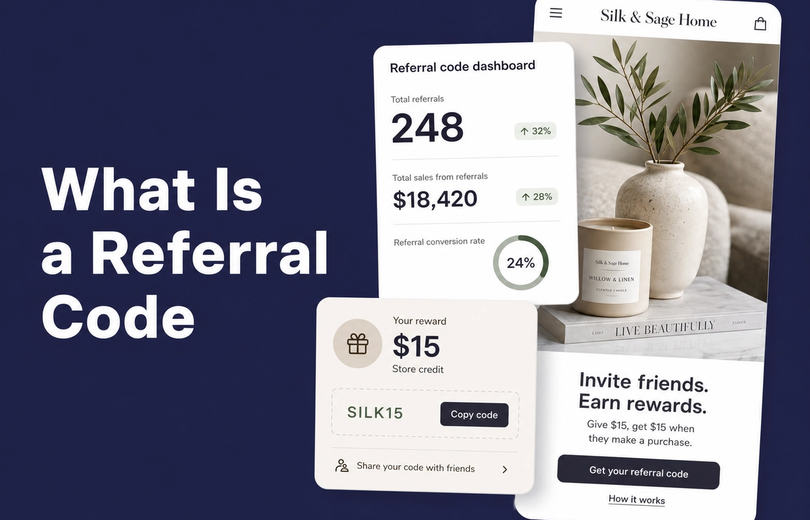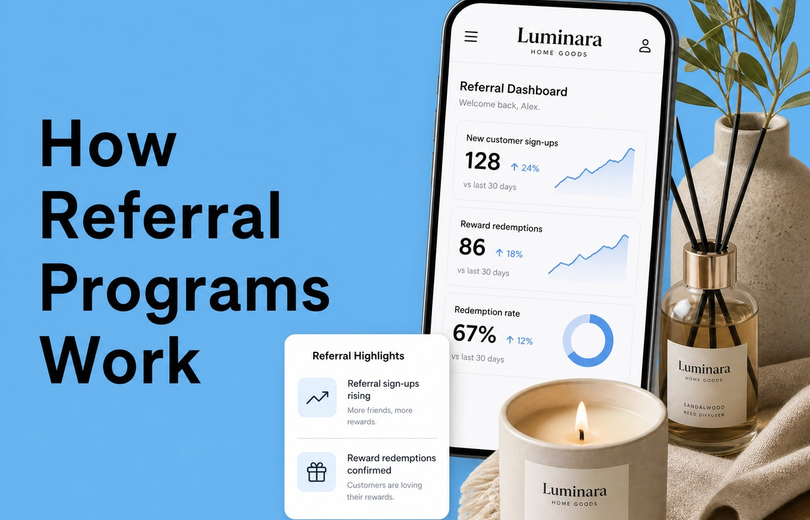
A referral program without discount code can track who referred a customer and issue a reward without asking that customer to type anything at checkout. The referral link records the introduction, while the reward is a separate decision about what the business wants to give.
Short answer: Yes. A referral program can use a unique referral link to connect a friend’s sign-up or purchase to the advocate who sent them. The resulting reward can be store credit, points, a gift, a free product, a donation, early access, or another benefit.
Referral Program Without Discount Code: Yes, Attribution and Rewards Are Separate
The core mechanism
A referral program without discount code works because attribution and reward delivery are two different jobs.
The referral link identifies the customer who introduced the friend. The reward is issued once that friend completes the action you defined, such as creating an account or placing an order.
Shopify discount codes require a customer to enter a specific code at checkout, according to Shopify’s discount-code guidance. A code is one delivery mechanism for a discount, not a requirement for proving who made the referral.
A shareable discount link can apply a discount automatically to an eligible cart, as Shopify explains. It is more convenient than typing a code, but it is still only one way to deliver an offer.
What the customer experiences
The advocate shares a personal link. Their friend clicks it, shops, and completes the qualifying action. The system then checks whether the referral meets the program rules and sends the configured reward.
With a Shopify referral program, Mage gives each participant a unique link and can count sign-up, purchase, or both as the conversion event. The friend does not need to manually enter a code for the referral to be attributed.
You can make the friend’s first purchase easier with an offer, reward the advocate after purchase, or skip discounts entirely and issue a different benefit.
The Myth: Every Referral Needs a Coupon Code
Why the myth persists
The familiar referral template is simple: “Give your friend 10% off, get 10% off.” Coupons are visible, easy to recognize, and validated at checkout.
That visibility can create the mistaken assumption that the code is doing the tracking. A unique referral link can establish the relationship before checkout, then the program checks whether the friend’s sign-up or purchase is eligible.
What replaces the code
A codeless flow is straightforward:
- An advocate shares a unique referral link.
- A friend clicks through to the store or a referral landing page.
- The referral context is retained while the friend signs up or shops.
- The merchant’s conversion rule is met.
- The advocate, the friend, or both receive the chosen reward.
Mage can define a referral conversion as sign-up, purchase, or both. It can issue rewards automatically after conversion, with timing delayed until the return window closes if needed.
The referral can be tracked without a code even if the eventual reward is a discount code. Or the merchant can issue store credit, points, a free product, or a custom merchant-fulfilled reward.
“I looked into so many different integrations for loyalty and referrals for our Shopify Store, but no one impressed me more than Mage on human connection, customer service, and value.”


Read the Reelie case study →
Why Merchants Move Beyond Discount Codes
Code leakage and coupon-site exposure
A reusable code can move beyond the intended friend-to-friend exchange through group chats, forums, or deal communities.
A unique referral link gives the merchant a clearer record of who invited the friend. It does not eliminate fraud or channel overlap, but it makes eligibility rules and referral records more useful than a generic promo code alone.
Mage includes controls for self-referrals and email aliases, so a customer cannot create a variation of their own email address to claim another referral reward.
Margin and brand-control problems
A first-order discount cuts the price immediately. For a low-margin business, that can leave little room for the referral cost and shipping.
For high-AOV or low-frequency products, a broad percentage-off offer can also feel out of place. Store credit changes the timing: the referred customer can buy at full price, then the advocate receives credit toward a later purchase.
When a code is still useful
Discount codes remain useful when the main goal is reducing first-purchase friction. Lower-AOV replenishment products with healthy margin can support a clear, immediate offer.
Shopify distinguishes manually entered codes, automatic discounts, and shareable discount links in its discount-management guidance. Choose the discount delivery method separately from the referral logic.
Referral Rewards Without Coupons: Match the Incentive to the Business
| Reward type | Best fit | Why it works | Watch-out |
|---|---|---|---|
| Store credit | Repeat-purchase brands | Encourages a future order | Needs a credible reason to return |
| Points | Existing loyalty programs | Builds toward larger rewards | Value must be easy to understand |
| Free product or gift | Brands with samples or accessories | Introduces another product | Fulfillment cost can rise quickly |
| Donation | Mission-led brands | Gives sharing a purpose beyond price | Cause and amount must be clear |
| Early access | Drops and limited inventory | Protects price and adds exclusivity | Only works if access is genuinely valuable |
| Custom experience | Premium or service-led brands | Can feel more personal than a discount | Requires manual fulfillment |
Store credit
Store credit fits businesses that want a referral reward to produce a second purchase. The advocate receives a balance to use later rather than a percentage reduction on an order they may have placed anyway.
Shopify identifies store credit as a possible loyalty and referral incentive in its store-credit documentation. In Mage, loyalty store credit is a Mage-managed balance redeemed through Mage rewards and checkout extensions. It should not be described as the customer’s Shopify-native store-credit balance.
Points
Points work well when referrals are one part of a broader loyalty program. Customers can earn through purchases, reviews, birthdays, and other actions, then save toward a reward they want.
Free products and gifts
A free product or gift works when you have a compelling sample, accessory, or lower-cost item. Mage supports referral rewards including free products, free shipping, points, and store credit. It also supports custom rewards that the merchant fulfills directly, such as a consultation or event invitation.
Donations
A donation can suit a mission-led brand with a specific cause customers recognize. Use plain terms about what triggers the donation and who receives it.
Early access and experiences
Early access can work for limited drops and seasonal launches. Private shopping, styling help, consultations, or event invitations can also fit premium categories.
For more options, see these experiential loyalty rewards beyond discounts and free products.
A referral program can be one-sided, rewarding only the advocate or friend. It can also be two-sided, with different rewards for each person.
Which Referral Reward Fits Your Price Point?
| Business profile | Good starting rewards | Avoid | Primary metric |
|---|---|---|---|
| Low AOV, frequent replenishment | Points, modest credit, free shipping, small gift | Complicated reward menus | Repeat purchase rate |
| Mid-priced products | Two-sided points or credit | Large universal discounts | Referral conversion rate |
| High AOV, low frequency | Fixed credit, premium gift, service | Broad percentage-off offers | Referred-customer margin |
| Luxury or brand-sensitive | Access, private experiences, intentional credit | Promotions that weaken price positioning | Qualified referral revenue |
Low-AOV and replenishment products
For consumables and repeat-order categories, keep the reward easy to explain. Modest store credit, points, free shipping, or a small gift can work because customers have a natural reason to come back.
Mid-priced products
Mid-priced products can support a two-sided structure. The friend may receive a first-order benefit, while the advocate receives points or credit after the friend completes a qualifying purchase.
Shopify presents 10% to 15% of AOV as a referral-bonus planning heuristic. Treat that as a starting calculation, not a universal answer.
High-AOV and occasional-purchase products
High-ticket products need more restraint. Fixed-value credit, premium gifts, complimentary services, early access, or private experiences usually give you more control than a broad percentage discount.
For loyalty programs for jewelry brands, spend-based status, anniversary benefits, early access, free shipping, and store credit often make more sense than a large percentage-off reward.
Luxury and brand-sensitive categories
Luxury customers often care about recognition, access, and service. A referral reward can reinforce that through private appointments, priority access, custom fulfillment, or a considered gift.
How Codeless Referral Tracking Works on Shopify
The click-to-conversion path
Start with a unique referral URL for each advocate. They share it through their preferred channel, and the friend lands on your store through that link.
Next, define what qualifies: a sign-up, a purchase, or both. After the qualifying action, the program checks eligibility and issues the relevant reward.
Mage follows this structure: advocates share a personal link, friends land on the store or a configured page, and referral attribution occurs automatically when the defined conversion happens.
Landing pages and delayed purchases
Send referral traffic to a dedicated landing page whenever possible. The page should explain the offer, show eligibility conditions, and give the friend a clear next step.
Mage lets merchants configure a referral landing URL and recommends a dedicated page with the campaign embed. A delayed reward is useful when returns are common, because the advocate can be rewarded after the order is less likely to be refunded.
Fraud and eligibility controls
Set rules before launch. Decide whether existing customers qualify, whether a minimum spend applies, and whether a reward expires.
Mage can block self-referrals and email aliases. Review program results and refund behavior over time.
How to Launch and Measure a Referral Program Without a Promo Code
Choose the conversion event
Choose one conversion event first: sign-up, purchase, or both. Purchase is usually the cleaner choice when you need to protect reward cost.
Set the reward and timing
Start with one primary reward. Decide whether the advocate, the friend, or both receive it, then set eligibility, minimum-spend, expiry, and return-window rules where relevant.
Track the right metrics
Track participation, link clicks, claims, conversion rate, completed referrals, revenue, AOV, reward cost, and referred-customer lifetime value. Compare referred customers with non-referred customers over time.
Shopify reports a typical ecommerce referral rate of 1% to 3% and average referral conversion of 2.5% to 3.5%. Use those figures as directional context, not a forecast for your store.
To assess the longer-term return, review how much a referral program can add to customer lifetime value.
Run a controlled test
Test one variable at a time. Compare store credit against points, or one-sided against two-sided rewards. Keep the landing page, audience, and conversion definition stable long enough to assess qualified revenue rather than just clicks.
If referral events need to reach your existing marketing stack, review the available Shopify loyalty integrations.
Frequently asked questions
Can a referral program work without a discount code?
A referral program can work without a discount code by using a unique referral link to attribute the friend’s conversion to the advocate. The reward can be points, store credit, free shipping, a free product, or another incentive that fits the program.
How does codeless referral tracking work?
Codeless referral tracking works when an advocate shares a unique link and the friend’s sign-up or purchase is connected to that link. The program checks whether the conversion meets eligibility rules and issues the configured reward to the advocate, the friend, or both.
What are the best referral rewards without coupons?
The best referral rewards without coupons are store credit, points, free products, gifts, exclusive access, experiences, and donations for mission-led programs. Choose based on AOV, margin, repeat-purchase behavior, and brand positioning.
Can I use store credit as a referral reward?
Store credit can be used as a referral reward when the goal is to encourage a future purchase rather than reduce the first order’s price. Merchants using Mage should distinguish its loyalty store-credit balance from Shopify-native store credit.
How do I stop referral rewards from being shared on coupon sites?
You can reduce referral reward misuse by using unique links instead of a universal reusable code, setting eligibility and expiry rules, and delaying rewards until after the return window. Fraud controls should also block self-referrals and email aliases.
What referral reward should I use for high-priced products?
A referral reward for high-priced products should usually preserve price integrity through fixed-value credit, premium gifts, complimentary services, early access, or private experiences. Broad percentage discounts can become expensive quickly and may weaken perceived value.
A discount code is optional. Build the program around accurate attribution, a conversion event that protects margin, and a reward customers will value enough to share for. See how Mage’s Shopify referral program handles link-based attribution, configurable conversion events, delayed rewards, and fraud controls.

Kris is the co-founder of Mage Loyalty. I spend most days talking to merchants, and making sure our customers get real results. If you run a Shopify store or Agency we should chat!